What Separates a Show-Quality Custom Car From an Average Modification? A Look at Craftsmanship, Fitment, and Finish
A vehicle can have expensive wheels, custom paint, modified bodywork, a redesigned interior, and premium accessories without actually achieving a show-quality result. High-end components can create an impressive starting point, but the finished vehicle is ultimately judged by how well those components are integrated. The difference often becomes visible in details that are easy to overlook at first. Panel gaps remain consistent. Body surfaces flow correctly. Custom components sit naturally within the original architecture. Paint has uniform texture and reflection. Interior materials are fitted precisely. Edges, seams, fasteners, and transitions are clean. Nothing appears unfinished or accidentally added. For owners considering show quality car customization in Miami, these details matter because show-level presentation is not created by a single modification. It is the cumulative result of craftsmanship, fitment, surface preparation, finishing, inspection, and attention to detail.
Show Quality Starts With Execution
A show-quality vehicle does not necessarily need the most extreme modifications. Instead, it needs a consistently high standard of execution.
A relatively subtle build can attract significant attention when every component is properly fitted and finished. Conversely, an aggressive build can appear ordinary when body panels are poorly aligned, surfaces are inconsistent, or aftermarket components look disconnected.
This distinction is important because customization is often evaluated through individual parts. A person may focus on a wheel design or paint color while overlooking the relationship between the components. Professional customization looks at the finished vehicle as a complete physical object.
Craftsmanship Is Visible in the Details
Craftsmanship is difficult to measure through a parts list.
Two vehicles can use the same body kit, wheels, paint system, and interior materials but produce dramatically different results because of the quality of installation and finishing.
Craftsmanship appears in panel transitions, mounting points, seams, edges, surface preparation, trim alignment, and final detailing. These areas may not be the most obvious features of the vehicle, but they strongly influence perceived quality.
On a high-end vehicle, factory construction already establishes a relatively precise standard. Custom work must meet or exceed that standard if the modification is expected to appear professionally integrated.
Fitment Is One of the Biggest Differences
Fitment refers to how accurately a component sits in relation to the surrounding vehicle.
A bumper can technically be installed while still having uneven gaps. A wheel can physically fit while having an inappropriate offset. A body panel can be attached while its surface does not align correctly with adjacent panels.
Show-quality work demands more than functional installation.
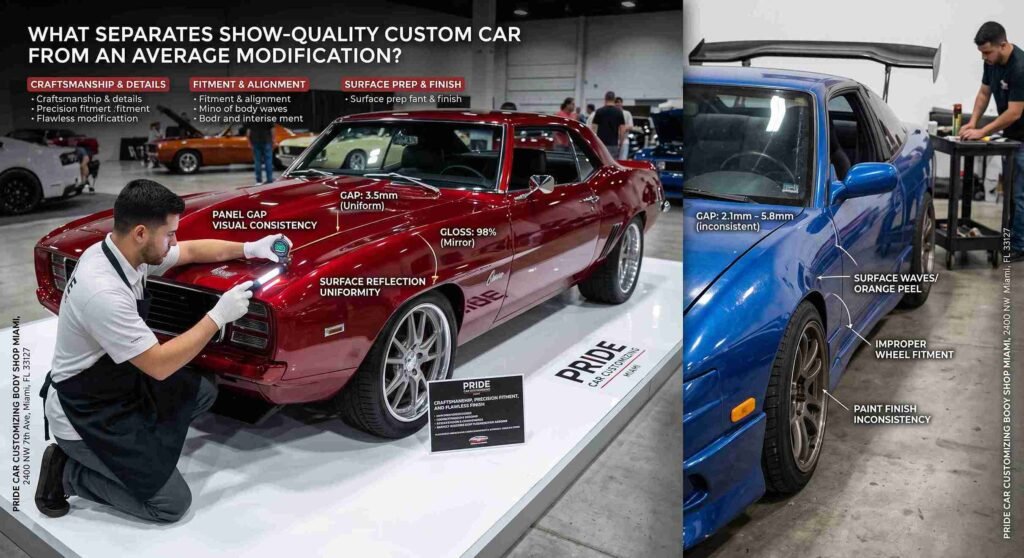
Panel gaps should be visually consistent. Body lines should continue naturally across modified sections. Components should sit correctly relative to the vehicle’s centerline and surrounding surfaces. This is particularly important for show quality custom cars in Miami, where vehicles are often viewed closely rather than simply passing by on the road.
Panel Gaps Reveal Professional Work
Panel gaps are one of the easiest ways to evaluate exterior workmanship.
Doors, hoods, trunks, bumpers, fenders, and other panels should maintain appropriate spacing and alignment. Inconsistent gaps can make even expensive customization look unfinished.
Custom bodywork can make this more challenging because aftermarket and fabricated components may not have the same tolerances as factory parts.
Professional technicians may need to adjust mounting points, modify components, refine edges, or perform additional bodywork to achieve the desired fit.
The extra time involved in these adjustments is often what separates installation from craftsmanship.
Surface Preparation Determines What the Eye Sees
A finished surface can only be as good as the foundation beneath it.
Custom bodywork may involve filler, fabrication, sanding, repair materials, primer, and surfacing stages before final paint is applied. Each stage should progressively improve the consistency of the surface. Poor preparation can leave waves, pinholes, sanding marks, uneven transitions, or subtle distortions that become highly visible under strong lighting. This is especially important for show vehicles because controlled lighting can reveal imperfections that ordinary daylight might not immediately expose. A show-quality finish therefore requires surface inspection throughout the process, not simply after the final coat.
Reflections Are a Useful Quality Indicator
Glossy automotive surfaces act almost like mirrors.
When a vehicle is viewed under strong directional lighting, reflected lines can reveal variations in body shape and surface texture. A smooth, properly prepared panel tends to produce controlled and consistent reflections.
Distorted reflections can indicate waviness or inconsistent surface preparation.
Professional custom car craftsmanship in Miami therefore involves more than making a panel feel smooth to the touch. The surface must also behave correctly visually when light interacts with it.
Paint Finish Requires Consistency
A high-quality paint finish should maintain consistent color, gloss, coverage, and surface texture across the vehicle.
This becomes more challenging when multiple panels have been modified or repaired.
The application process needs to control material distribution and minimize differences between adjacent surfaces. Clear coat application, curing, and subsequent finishing also influence the final appearance.
A show-quality vehicle should not have one panel that appears noticeably different from another under the same lighting conditions.
Edges and Transitions Matter
Some of the most revealing details are found around edges.
Body modifications often create new transitions between original and custom surfaces. These areas need to be shaped, finished, and painted so the transition appears intentional.
Poorly finished edges can reveal where an aftermarket component begins or where a repair was performed.
The objective is not necessarily to make every modification invisible. It is to ensure that the transition looks professionally engineered and visually appropriate.
Custom Fabrication Requires Patience
Some high-end projects require components to be modified or fabricated rather than installed directly from a manufacturer.
Custom fabrication can involve shaping materials, creating mounting solutions, refining contours, and repeatedly test-fitting components.
The first fit is not always the final fit.
A professional fabrication process may require multiple adjustment cycles before the component reaches the desired position and relationship with the vehicle.
This iterative process is one reason high-quality customization cannot always be judged by installation speed.
Wheel Fitment Goes Beyond Appearance
Wheels are highly visible, but show-quality wheel installation involves more than selecting an attractive design.
Wheel diameter, width, offset, tire dimensions, brake clearance, fender relationship, and suspension geometry all need to be considered.
The wheels should sit correctly within the arches and maintain an intentional relationship with the body.
Excessive poke, excessive tuck, inconsistent wheel positioning, or inappropriate tire proportions can undermine an otherwise sophisticated build.
The technical fit must also be appropriate for the vehicle’s intended use.
Interior Craftsmanship Is Equally Important
A show-quality exterior can be undermined by an average interior.
Custom leather, upholstery, headliners, panels, lighting, trim, and other interior modifications should be executed with the same attention to fit and finishing.
Stitching should be consistent. Seams should follow the intended geometry. Materials should be properly tensioned. Trim should sit securely without unnecessary gaps or movement.
The quality of an interior becomes especially apparent when occupants are close to the work. Small inconsistencies that may be invisible from outside become immediately noticeable inside the cabin.
Material Installation Affects Perceived Luxury
Expensive material does not automatically look expensive after installation.
Leather, carbon fiber, wood, aluminum, Alcantara-style materials, and premium trim can all lose their visual impact when incorrectly fitted.
Material direction, grain, seams, joins, edges, and transitions need to be considered.
A premium material should appear intentionally integrated rather than attached to an existing surface.
This principle applies across premium auto customization in Miami, whether the project involves a complete interior transformation or a small number of carefully selected upgrades.
Detailing Is Not a Substitute for Craftsmanship
Professional detailing can dramatically improve a finished vehicle, but detailing cannot correct fundamental fabrication or fitment problems.
Polishing may improve paint gloss, but it cannot straighten a distorted panel. Cleaning can enhance an interior, but it cannot correct poorly aligned stitching. Ceramic coating can protect a finish, but it cannot repair inadequate surface preparation.
Show-quality results therefore require craftsmanship first and detailing afterward.
Detailing should reveal the quality of the work rather than attempt to disguise deficiencies.
Lighting Exposes What Normal Conditions Hide
A vehicle can look excellent in ordinary outdoor lighting while revealing imperfections under controlled inspection lighting.
Strong LED lighting, directional reflections, and different viewing angles can expose surface defects, uneven texture, paint inconsistencies, and poor transitions.
For this reason, final inspection should involve more than walking around the vehicle in a parking area.
Professional quality control should deliberately examine the vehicle under conditions that make imperfections easier to identify.
Final Inspection Should Be Systematic
A high-end custom vehicle deserves a structured final inspection.
Exterior inspection should examine panel alignment, gaps, body contours, paint consistency, trim installation, wheel positioning, glass, lighting, and exterior finishes.
Interior inspection should examine upholstery, stitching, trim, electronics, controls, carpeting, headliner installation, and overall cleanliness.
Functional checks should also be performed on relevant components.
This process is important because final assembly can introduce small issues that were not present during earlier stages.
Presentation Completes the Build
Show quality is partly about how the vehicle presents as a finished object.
After technical work is completed, professional cleaning and detailing remove residue, dust, fingerprints, installation marks, and other signs of the construction process.
Glass should be clean. Trim should be properly finished. Wheels and tires should be presented consistently. Interior surfaces should be clean and properly conditioned according to their materials.
The purpose of detailing is not excessive decoration. It is to present the craftsmanship without distractions.
Consistency Matters More Than One Impressive Feature
An average modification often has one or two standout components.
A show-quality vehicle tends to maintain a consistent level of quality across the entire build.
An exceptional paint job does not compensate for poor wheel fitment. Perfect wheels do not compensate for uneven bodywork. A beautiful interior does not compensate for inconsistent exterior finishing.
The strongest result is therefore built around consistency.
Every visible and functional element should support the same standard.
Avoiding the “Aftermarket Parts” Appearance
One common problem in customization is the appearance of a vehicle assembled from unrelated aftermarket components.
This can happen when modifications are selected independently without considering their physical integration or finishing.
Show-quality work takes the opposite approach. Components are evaluated according to how they interact with the rest of the vehicle.
Even highly customized vehicles can retain a sense of factory-level coherence when materials, surfaces, proportions, fitment, and finishing are carefully controlled.
Show Quality Does Not Mean Excessive Modification
A show-quality build does not necessarily need to be extreme.
Quality and quantity are different concepts.
A vehicle with carefully refinished original panels, precision wheel fitment, subtle custom detailing, premium interior work, and exceptional paint quality can demonstrate more craftsmanship than a vehicle covered in modifications.
The defining characteristic is execution.
Owners should therefore establish whether they want visual drama, technical craftsmanship, preservation, personalization, or a combination of these objectives before selecting modifications.
Maintenance Protects the Finished Result
After considerable time and effort has been invested in customization, maintenance becomes part of preserving the result.
Paint should be washed using methods appropriate for the finish. Wheels and specialized surfaces should receive compatible care. Interior materials should be cleaned with products suited to their composition.
Protective services such as paint protection film or ceramic coating may also be considered depending on the vehicle and usage pattern.
A show-quality vehicle requires ongoing care because even excellent workmanship cannot prevent damage caused by neglect or inappropriate maintenance.
Selecting a Shop for Show-Quality Customization
When evaluating a customization shop, look closely at completed vehicles rather than relying exclusively on marketing claims.
Inspect photographs for panel gaps, wheel positioning, surface reflections, paint transitions, interior stitching, trim alignment, and overall consistency.
If possible, examine finished vehicles in person.
Ask how the shop handles surface preparation, fabrication, fitment, refinishing, component installation, and final quality control. A professional provider should be able to explain these processes clearly.
Experience matters, but so does the shop’s willingness to spend time refining details that may not be obvious in an initial inspection.
Show Quality Car Customization in Miami
Achieving a show-quality result requires a higher standard than simply installing premium parts. It requires careful preparation, accurate fitment, disciplined fabrication, consistent finishing, detailed inspection, and professional presentation.
At Pride Car Customizing Body Shop Miami, vehicle owners can explore custom bodywork, paint, wheel and caliper work, interior customization, vehicle wraps, detailing, paint protection, and other automotive customization services based on the scope of their project.
For anyone seeking show quality car customization in Miami, the most important question is not how many modifications can be added to the vehicle. It is whether every modification can be executed to a consistent professional standard.
A show-quality vehicle should withstand close inspection. Its craftsmanship should remain evident from the overall silhouette down to the smallest visible transition.
Conclusion
The difference between an average modification and a show-quality custom vehicle is rarely one dramatic component. It is found in the accumulation of precise decisions and careful execution.
Craftsmanship creates the foundation. Fitment makes components appear integrated. Surface preparation creates a clean canvas. Paint and finishing establish visual consistency. Interior workmanship extends the same standard into the cabin, while inspection and detailing ensure the finished vehicle can withstand close examination.
For owners seeking show quality car customization in Miami, the ultimate objective should be consistent quality throughout the entire vehicle. When every panel, component, surface, material, and finish receives the same level of attention, customization becomes more than modification. It becomes professional automotive craftsmanship.
Pride Car Customizing Body Shop Miami
2400 NW 7th Ave, Miami, FL 33127
Phone: +1 305-498-6789