Custom vs OEM Replacement Panels A Technical Guide to Fitment, Finish Quality, and Long-Term Results
When a vehicle requires body-panel replacement, the decision is rarely as simple as choosing a new panel and installing it. The replacement component must work with the vehicle’s existing structure, mounting points, body lines, trim, paint system, and surrounding panels. For Miami vehicle owners, the choice between OEM replacement panels Miami, aftermarket components, repaired original panels, and custom-fabricated body panels can have a significant effect on the finished vehicle. Fitment, material characteristics, corrosion resistance, surface preparation, paint matching, and installation quality all contribute to the final result. The right solution depends on the vehicle, the type and extent of damage, the purpose of the repair, and the desired outcome. A collision-damaged daily driver may require a different approach from a luxury vehicle undergoing restoration or a custom build. Understanding the technical differences between these options helps vehicle owners make a more informed decision before bodywork begins.
What Makes a Body Panel More Than Just a Piece of Metal?
A body panel may appear to be a simple exterior component, but its relationship with the vehicle is highly specific. Its dimensions, curvature, mounting points, reinforcement areas, attachment locations, edges, openings, and interfaces with adjacent components are designed around a particular vehicle platform. A replacement panel therefore needs to reproduce more than the general shape. It needs to interact correctly with the surrounding vehicle. This is where fitment becomes critical. A panel that technically attaches to the vehicle but creates inconsistent gaps, incorrect contours, trim interference, or alignment problems cannot be considered an ideal repair simply because it is physically installed.
OEM Replacement Panels and Factory Specifications
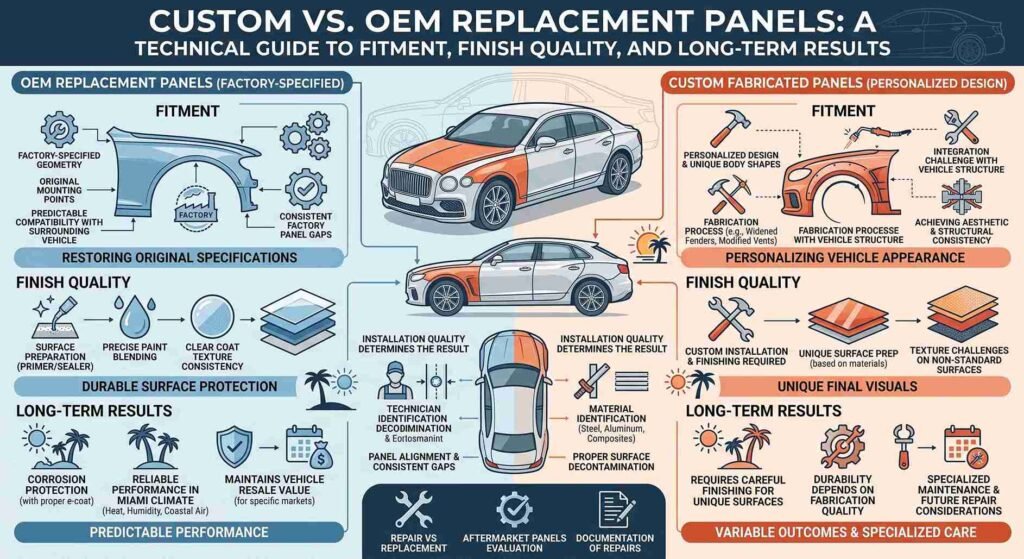
OEM panels are produced for a specific vehicle manufacturer and model application. Their design is intended to correspond with the original vehicle’s body architecture. One of the primary advantages is predictable compatibility with the vehicle’s existing geometry. For vehicles where maintaining factory specifications is important, OEM components can provide a straightforward path toward restoring the original configuration. This can be particularly relevant for newer vehicles, premium automobiles, collector vehicles, and repairs where maintaining original design characteristics is a priority. However, installing an OEM panel does not automatically guarantee a perfect repair. The panel still needs to be installed correctly, aligned with adjacent components, prepared appropriately, and refinished to match the rest of the vehicle. The component is only one part of the repair process.
Repaired Original Panels Versus Replacement
Replacement is not always the correct solution.
If the original panel has sustained damage that can be safely repaired, restoring the existing component may preserve the original fitment and reduce the need to replace a factory panel.
The decision depends on factors such as damage location, severity, panel material, deformation, access to the damaged area, structural considerations, and the desired finish.
A professional technician should evaluate whether the original panel can be restored to an appropriate standard rather than automatically replacing it.
For some dents and localized damage, retaining the original panel can be a practical solution. For severely distorted, torn, corroded, or otherwise compromised panels, replacement may be more appropriate.
Aftermarket Panels: Where Fitment Can Become More Complex
Aftermarket replacement panels can provide another option, but quality and consistency vary between manufacturers and applications.
Even when a panel is marketed as compatible with a particular vehicle, its dimensions, stamping accuracy, material characteristics, mounting points, and surface condition may differ from the original component.
Small dimensional differences can create larger problems during installation. A slight variation in an edge or mounting point can affect panel gaps, adjacent trim, bumper alignment, or the relationship between multiple body components.
This does not mean aftermarket panels are inherently unsuitable. It means that the individual component needs to be evaluated for the specific repair.
Custom Body Panels Serve a Different Purpose
Custom body panels in Miami are generally associated with vehicle customization rather than straightforward factory restoration.
Custom fabrication can be appropriate when an owner wants a unique body shape, widened fenders, modified panels, specialty vents, custom openings, or other changes that are not available through the factory parts system.
The fabrication process may involve shaping, cutting, forming, bonding, welding, composite work, or other specialized techniques depending on the material and design.
The challenge is achieving both aesthetic and structural consistency.
A custom panel should not simply look different. It needs to integrate with the vehicle’s surrounding bodywork and support the intended use of the automobile.
Fitment Is the First Quality Test
Before paint is applied, the panel should be evaluated for fitment.
This includes checking panel gaps, body contours, mounting points, edge relationships, and alignment with neighboring components.
A professional installation may involve adjustment before the panel reaches the refinishing stage. This is important because correcting fitment after paint can create unnecessary risk and additional work.
The objective is to establish the correct physical relationship between components first.
Only then should the surface be prepared for final finishing.
Panel Alignment and Consistent Gaps
Modern vehicles are designed with deliberate relationships between body panels.
The gap between a hood and fender, for example, needs to remain visually consistent. Door-to-fender relationships, bumper transitions, trunk interfaces, and other panel gaps contribute significantly to the perception of quality.
Uneven gaps can indicate incorrect installation, incompatible components, structural movement, or inadequate adjustment.
For car panel replacement in Miami, these details are particularly important because strong natural light can reveal inconsistencies that may not be obvious inside a workshop.
A professional repair should therefore evaluate the vehicle from multiple angles and under appropriate lighting before final delivery.
Material Matters: Steel, Aluminum, and Composite Components
Not all body panels behave in the same way.
Steel panels have different forming, repair, corrosion, and finishing characteristics from aluminum components. Composite materials introduce another set of considerations.
The repair technique must correspond to the material.
Improper repair methods can compromise panel integrity or create future problems. Material-specific preparation and joining techniques may be necessary depending on the component.
This is one reason a technician should identify the panel material before deciding how to repair or replace it.
Structural Components Require Additional Consideration
Some exterior panels are primarily cosmetic, while other body components have structural or semi-structural functions.
The distinction matters.
If collision damage extends beyond the visible panel into reinforcement structures, mounting points, pillars, rails, or other structural areas, replacing the visible panel alone may not restore the vehicle correctly.
A proper collision assessment should determine whether underlying components have been affected.
For serious collision damage, measurements and manufacturer-specific repair procedures may also become relevant.
The goal is not simply to make the vehicle look straight. The repair should address the actual damage.
Surface Preparation Determines the Final Finish
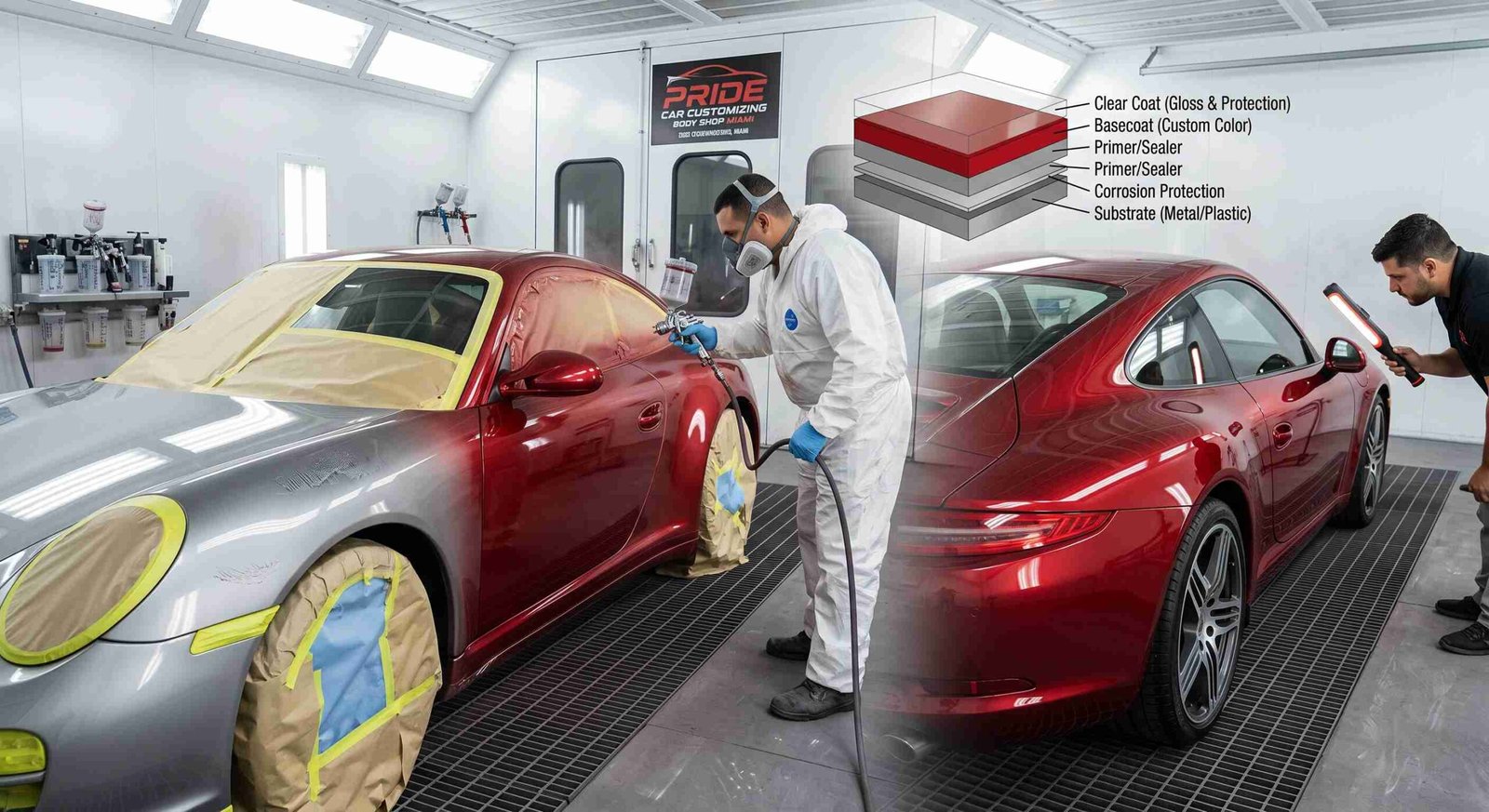
Even a precisely manufactured replacement panel requires proper surface preparation before painting.
The surface may need cleaning, sanding, priming, sealing, or other preparation depending on its condition and the manufacturer’s finish.
Poor preparation can contribute to adhesion problems, texture inconsistencies, contamination, or premature deterioration.
This is why the quality of an OEM body panel in Miami cannot be evaluated independently from the refinishing process.
The panel provides the physical foundation. Preparation and paint application determine much of the visible result.
Paint Matching Is More Complicated Than Matching a Color Code
Factory paint codes provide valuable information, but matching an existing vehicle is not necessarily as simple as applying the same code to a replacement panel.
A vehicle’s paint can change over time due to UV exposure, environmental conditions, previous refinishing, polishing, and normal aging.
Even the same color can appear different depending on application technique, substrate, lighting, and surrounding surfaces.
Professional refinishing may therefore involve color evaluation and blending into adjacent panels when appropriate.
The objective is to create a visually consistent transition rather than simply applying a nominally identical paint formula.
Clear Coat and Texture Consistency
Color is only one part of the finished appearance.
Clear-coat thickness, gloss level, texture, and application characteristics also affect how a repaired panel looks next to original paint.
If one panel has a significantly different surface texture or gloss level, the repair may remain visually obvious even when the color is close.
Professional refinishing therefore considers the entire paint system.
The final surface may also require controlled polishing or refinement after curing to achieve the desired level of gloss and consistency.
Corrosion Protection in Miami’s Climate
Miami’s heat, humidity, rainfall, and coastal environment make proper protection of exposed metal particularly important.
Damage to paint, seams, edges, or protective coatings can create opportunities for moisture and contaminants to reach underlying materials.
Replacement and repair work should therefore include appropriate attention to corrosion prevention.
This is particularly relevant around panel edges, fasteners, seams, and areas where the original protective system has been disturbed during repair.
A visually perfect panel is not a complete repair if underlying protection has been neglected.
When Customization and Replacement Overlap
Some projects involve both replacement and customization.
A damaged factory panel might first need replacement before the vehicle receives a custom body modification. Alternatively, an OEM component could provide the structural or dimensional foundation for a customized exterior design.
This is where traditional body repair and customization capabilities can overlap.
The important consideration is maintaining a logical sequence. Structural and fitment work should be completed before final refinishing and protective treatments.
This reduces the possibility of damaging newly finished surfaces during later fabrication.
Choosing Between OEM, Repair, Aftermarket, and Custom
There is no universal answer for every vehicle.
Repairing the original panel may make sense when damage is localized and the component remains suitable for restoration.
An OEM replacement may be appropriate when the original panel is severely compromised and maintaining factory specifications is important.
An aftermarket panel may be considered when availability, project requirements, or other practical factors make it appropriate, provided its quality and fitment are acceptable.
Custom fabrication becomes relevant when the objective extends beyond restoring the original vehicle and enters the realm of personalization or performance-oriented body modification.
The decision should be based on the vehicle and the intended result rather than on the label attached to the component.
Why Installation Quality Determines the Result
A high-quality replacement panel can still produce a poor result if installation is rushed.
The technician must work with the surrounding structure, mounting hardware, trim, lights, bumpers, doors, and adjacent panels.
Alignment may require repeated adjustment before the final fit is achieved.
This is particularly important for premium vehicles because small inconsistencies can become highly visible once the vehicle is completely refinished.
Professional auto body repair in Miami should therefore emphasize the complete repair system rather than treating panel installation as an isolated task.
OEM Replacement Panels and Vehicle Value
For certain vehicles, maintaining factory specifications can be important to long-term ownership considerations.
A properly installed OEM component can help preserve the vehicle’s original configuration, particularly when the goal is restoration rather than customization.
However, vehicle value depends on many factors, including overall condition, maintenance history, originality, documentation, model, mileage, and market demand.
A replacement panel alone does not determine a vehicle’s future value.
For valuable vehicles, documenting repairs and retaining relevant records can nevertheless provide useful information about the vehicle’s history.
Inspecting the Finished Repair
Final inspection should occur after assembly and refinishing are complete.
The vehicle should be examined for panel alignment, consistent gaps, paint color, gloss, texture, trim fitment, hardware, and operation of affected components.
Doors, hoods, trunks, lights, sensors, and other components disturbed during the repair should also be checked as appropriate.
The final objective is a repair that looks coherent from different viewing angles and functions correctly under normal use.
This final inspection is especially important because defects that were difficult to see during individual stages may become obvious when the vehicle is completely assembled.
The Right Panel Is Only the Beginning
Choosing between an original panel repair, an OEM replacement, an aftermarket component, or custom fabrication requires more than comparing prices or availability. The real objective is to achieve appropriate fitment, correct alignment, durable surface protection, consistent paint quality, and a finished result that suits the vehicle.
For OEM replacement panels Miami, professional evaluation is particularly important when the vehicle is a luxury automobile, a performance model, a restoration project, or part of a larger customization build. At Pride Car Customizing, bodywork, refinishing, customization, and exterior finishing can be approached as connected stages of the same vehicle project. Whether the objective is restoring damaged bodywork or developing a more customized appearance, the quality of the underlying panel work directly influences the finished vehicle.