Automotive Color Transformation How Paint Chemistry, Surface Preparation, and Application Technique Determine the Final Finish
A complete automotive color transformation is far more involved than selecting a new color from a paint catalog. The final appearance of a vehicle depends on a chain of technical decisions involving paint chemistry, substrate preparation, primer selection, application technique, environmental control, curing, and finishing. For owners considering custom car paint in Miami, understanding this process is valuable because a custom color is only as successful as the system used to produce it. A visually impressive color can still produce an unsatisfactory result if the underlying surface is improperly prepared, the paint system is incompatible, or application conditions are poorly controlled. Professional automotive painting treats the vehicle as a technical substrate rather than a blank canvas. Every layer has a function, and each stage influences the next. The objective is to create a uniform surface that allows the selected color and finish to perform as intended.
Automotive Color Is a Multi-Layer System
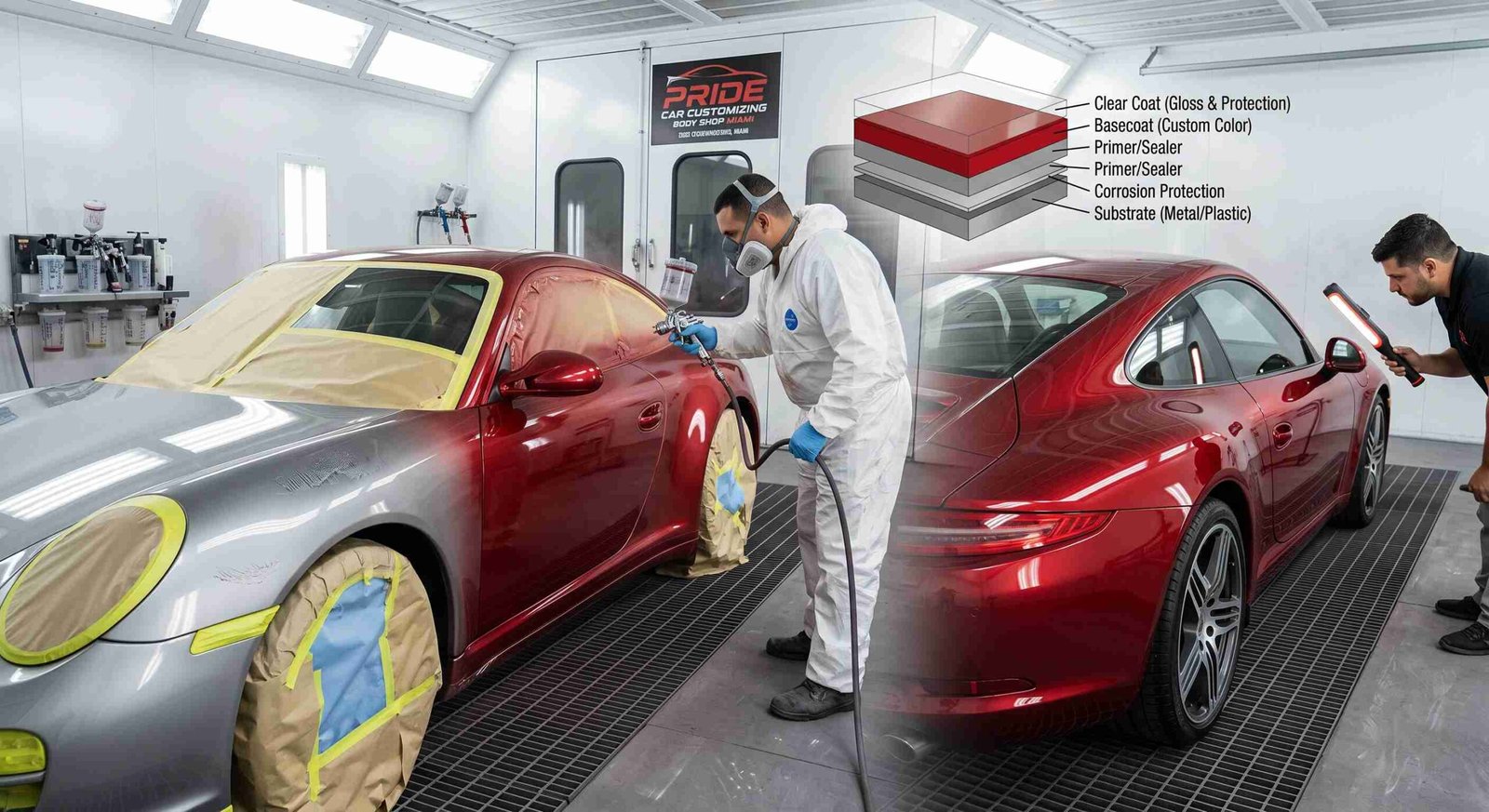
What appears to be a single color on a finished vehicle is actually the result of multiple layers working together. A typical refinish system can include substrate preparation, corrosion protection where required, primer or sealer, basecoat, specialty effect layers when applicable, and clear coat. Each layer affects adhesion, appearance, durability, and the optical characteristics of the final surface. This becomes even more important with custom colors. A solid color, metallic finish, pearl effect, candy-style finish, matte system, or multi-stage color can respond differently to surface conditions and application variables. The same spray technique cannot necessarily be applied identically to every type of finish.
Professional custom automotive paint in Miami therefore begins with selecting a paint system that is appropriate for the desired visual effect and the vehicle’s existing substrate.
Paint Chemistry Determines More Than Color
Automotive refinishing materials are engineered formulations rather than ordinary decorative paints. Their binders, pigments, solvents or reducers, additives, and curing mechanisms influence how the material behaves during application and after it has cured.
Pigments determine much of the visible color, while the binder system helps establish how the coating adheres and forms a continuous film. Reducers and related components influence viscosity, evaporation, flow, and spray behavior.
Clear coat chemistry contributes significantly to gloss, depth, chemical resistance, and surface protection.
The interaction between these components matters. Using a product outside its intended system or mixing materials without following manufacturer specifications can produce adhesion problems, uneven appearance, solvent-related defects, or premature deterioration.
A professional custom car painting in Miami project should therefore use a controlled coating system rather than treating automotive paint as interchangeable material.
Color Formulation Requires Precision
Custom color work can involve selecting an existing manufacturer color, modifying an established formula, or developing a completely different visual direction.
Color formulation becomes particularly demanding when the desired finish contains metallic or pearl effects. The final appearance can change according to pigment concentration, particle orientation, film thickness, application technique, and viewing angle.
Two panels painted with technically similar material can sometimes appear different if the application process is inconsistent.
This is why color development should not be separated from the application process. The selected formula needs to be evaluated under realistic application conditions before the complete vehicle is transformed.
For a major automotive color change in Miami, professional color evaluation helps reduce the risk of discovering unexpected variations only after the vehicle has been fully painted.
Surface Preparation Is the Foundation of the Finish
One of the most important principles in automotive painting is that paint cannot compensate for a poorly prepared substrate.
Surface preparation determines how effectively the coating system can bond to the vehicle. Existing paint, repaired areas, bare metal, plastic components, and previously refinished surfaces can each require different preparation methods.
The surface must be clean and appropriately prepared before primer, sealer, or basecoat is applied. Contaminants such as waxes, oils, silicone-based residues, dust, and other substances can interfere with adhesion and create defects.
Sanding also has a specific purpose. It creates the appropriate surface profile while removing imperfections and preparing the existing coating for the next stage. The goal is not simply to make the surface look smooth. It is to create a technically suitable substrate for the complete coating system.
Bodywork Quality Directly Affects Paint Quality
Paint magnifies surface irregularities.
Small dents, sanding marks, pinholes, waviness, uneven filler transitions, and poorly repaired contours can become highly visible once the surface receives a glossy finish.
This is particularly noticeable with dark colors and high-gloss finishes because reflected light makes surface inconsistencies easier to identify.
Before applying the final color, professional bodywork should establish accurate panel contours and controlled surface transitions. Filler materials should be used appropriately, repaired areas should be properly shaped, and sanding should progressively refine the surface.
This relationship between bodywork and paint is one reason high-quality custom vehicle paint in Miami cannot be evaluated solely by the spray application itself.
Primers and Sealers Establish the Intermediate Surface
Primer is not simply an undercoat chosen because it happens to be available. Different primer technologies perform different functions.
Depending on the substrate and repair requirements, a system may need corrosion-resistant primers, surfacing primers, adhesion-promoting products, or sealers. The correct choice depends on the material being coated and the requirements of the paint system.
A sealer can also help create a more uniform foundation before color application. This can be particularly useful when the underlying surface contains different colors or materials.
Uniformity at this stage can contribute to more consistent color development in the basecoat.
Film Thickness Can Influence Appearance
The amount of coating applied matters.
Too little material can compromise coverage and protection, while excessive film build can introduce its own problems. The correct film thickness depends on the coating system and manufacturer specifications.
With certain colors and effect finishes, film thickness can also influence visual consistency.
This is one reason professional painters do not simply judge application by whether a panel “looks covered.” Coating systems are designed to perform within defined application parameters.
Consistent application across large panels is particularly important during a full vehicle transformation because variations can become visible when adjacent panels are viewed together.
Spray Technique Influences the Final Color
Application technique is one of the most important variables in automotive painting.
Gun distance, angle, overlap, travel speed, atomization, air pressure, fluid delivery, and spray pattern can all influence how material is deposited onto the surface.
Metallic and pearl finishes can be especially sensitive to application consistency because the orientation of effect particles affects how light reflects from the surface.
If one panel receives a different spray pattern from another, the same paint formula may produce a slightly different visual result.
Professional luxury car paint in Miami therefore requires controlled application rather than simply applying more coats until the desired color appears.
Environmental Conditions Matter
Automotive paint systems are sensitive to their application environment.
Temperature, humidity, airflow, contamination levels, and booth conditions can affect evaporation, flash time, atomization, curing, and final surface quality.
Miami’s warm and humid environment makes environmental control particularly relevant. A controlled professional painting environment allows the application process to be managed more consistently than an uncontrolled outdoor or improvised setting.
The goal is not to eliminate every environmental variable but to maintain conditions that are appropriate for the coating system being used.
Flash Time Between Coats Is Part of the Process
A coating layer needs appropriate time to release solvents and reach the condition required for the next application stage.
Applying the next layer too quickly can trap solvents or interfere with the coating’s behavior. Excessive waiting under unsuitable conditions can create other complications.
Flash time therefore needs to be controlled according to the material system and environmental conditions.
This illustrates an important point about automotive painting: quality is influenced not only by what is applied but also by when it is applied.
Clear Coat Changes the Visual Character of the Color
A clear coat is transparent, but its influence on the final appearance is substantial.
It can affect gloss, depth, reflection, texture, and perceived richness. A properly applied clear system can make a color appear deeper and more uniform while providing an additional protective layer.
Clear coat application also requires technical control. Uneven application can produce differences in gloss or surface texture, while excessive material can create runs, sags, or other defects.
The final appearance is therefore the cumulative result of everything underneath the clear layer.
Specialty Finishes Require Additional Control
Some custom finishes require more complex application strategies than a conventional solid color.
Pearlescent finishes, multi-stage colors, candy-style systems, color-shifting effects, and other specialty finishes can involve multiple layers or carefully controlled application techniques.
The visual result may depend on how effect pigments interact with the underlying ground coat and subsequent layers.
These finishes can also make repairs and future color matching more demanding. A small variation in application technique can be more noticeable than it would be with a conventional solid color.
For owners seeking distinctive professional car painting in Miami, this is an important consideration when selecting a specialty finish.
Matte and Satin Finishes Have Different Requirements
Gloss is not the only measure of a successful automotive finish.
Matte and satin systems produce their visual character through controlled surface reflection. Because the surface does not reflect light in the same way as a traditional high-gloss finish, imperfections and inconsistent texture can become difficult to correct.
A matte finish also requires different maintenance considerations after completion. Aggressive polishing, for example, is not treated the same way as it would be on conventional gloss paint.
Choosing a low-gloss custom finish should therefore involve consideration of both appearance and long-term maintenance.
Color Transformation Requires More Than Exterior Panels
A complete color change raises an important question: how much of the original color should be changed?
If only the exterior-facing portions of panels are painted, areas such as door jambs, inner edges, trunk openings, engine-bay areas, or other visible sections may retain the original color.
Whether those areas should be transformed depends on the scope of the project and the desired level of conversion.
A high-quality color transformation should establish the intended scope before work begins. This prevents a mismatch between customer expectations and the actual extent of the paint project.
Removing and Reinstalling Components Can Affect the Result
Professional color transformation often requires access to areas that cannot be properly painted while components remain installed.
Depending on the vehicle and project scope, bumpers, lights, trim, handles, emblems, moldings, or other components may need to be removed.
Proper disassembly can improve access and help create cleaner transitions. However, reassembly must also be handled carefully to prevent damage to freshly finished surfaces and to ensure components return to their correct positions.
A professional painting project therefore includes more than spraying. It involves controlled disassembly, preparation, application, curing, finishing, and reassembly.
Final Finishing Reveals the Quality of the Transformation
Once the coating system has cured appropriately, the vehicle may require final finishing work.
This can include inspection under controlled lighting, identification of surface defects, refinement of texture where appropriate, and final detailing according to the coating system.
The objective is not necessarily to make every surface artificially perfect through aggressive correction. Instead, the finishing process should preserve the integrity of the newly applied system while achieving the intended visual character.
Final inspection should examine the vehicle from multiple angles and under different lighting conditions. A finish that looks excellent in one environment may reveal inconsistencies under stronger directional lighting.
Maintaining a Custom Paint Transformation
A professional paint transformation does not end when the vehicle leaves the shop.
The owner’s maintenance practices can influence how long the finish retains its appearance. Appropriate washing methods, compatible detailing products, protection strategies, and careful handling can reduce unnecessary surface wear.
For vehicles exposed to intense Miami sunlight, rain, humidity, road contaminants, and frequent driving, ongoing surface care becomes particularly important.
Protection options can include paint protection film or ceramic coating, depending on the vehicle, finish, usage pattern, and owner’s objectives. These systems should be selected after considering the characteristics of the new paint rather than simply adding protection without evaluating compatibility and installation requirements.
Choosing the Right Approach to Custom Car Paint
A successful color transformation begins with defining the intended result.
The vehicle’s current condition, existing paint system, desired color, finish type, scope of color conversion, daily usage, and long-term maintenance requirements should all be considered before work starts.
Owners should also evaluate the shop’s approach to surface preparation, paint-system selection, color matching, spray application, environmental control, and final inspection.
A professional shop should be able to explain the process rather than quote a price for “a new paint job.” The quality of the final result depends on numerous technical decisions that occur before the paint is sprayed.
Custom Car Paint in Miami With a Professional Approach
A successful automotive color transformation combines chemistry, preparation, application, finishing, and craftsmanship. The color itself is only one component of the final result.
At Pride Car Customizing Body Shop Miami, vehicle owners can explore custom automotive painting and broader vehicle customization services based on the desired transformation and condition of the vehicle. For anyone considering custom car paint in Miami, the key is to think beyond color selection. The substrate must be prepared correctly, the coating system must be appropriate, application variables must be controlled, and the final surface must be inspected and maintained properly. When these elements are handled as one technical process, a color transformation can achieve the depth, consistency, and professional appearance expected from a high-end custom vehicle.
Conclusion
Automotive color transformation is a technical process in which every stage contributes to the final appearance. Paint chemistry determines how the coating behaves, surface preparation establishes the foundation, application technique controls material distribution, environmental conditions influence curing, and finishing determines how the completed surface presents under light. For Miami vehicle owners, selecting custom car paint in Miami should therefore involve more than choosing an attractive color. The quality of the preparation, materials, application, and finishing process ultimately determines whether that color becomes a durable, professionally executed vehicle transformation.
Pride Car Customizing Body Shop Miami
2400 NW 7th Ave, Miami, FL 33127
Phone: +1 305-498-6789