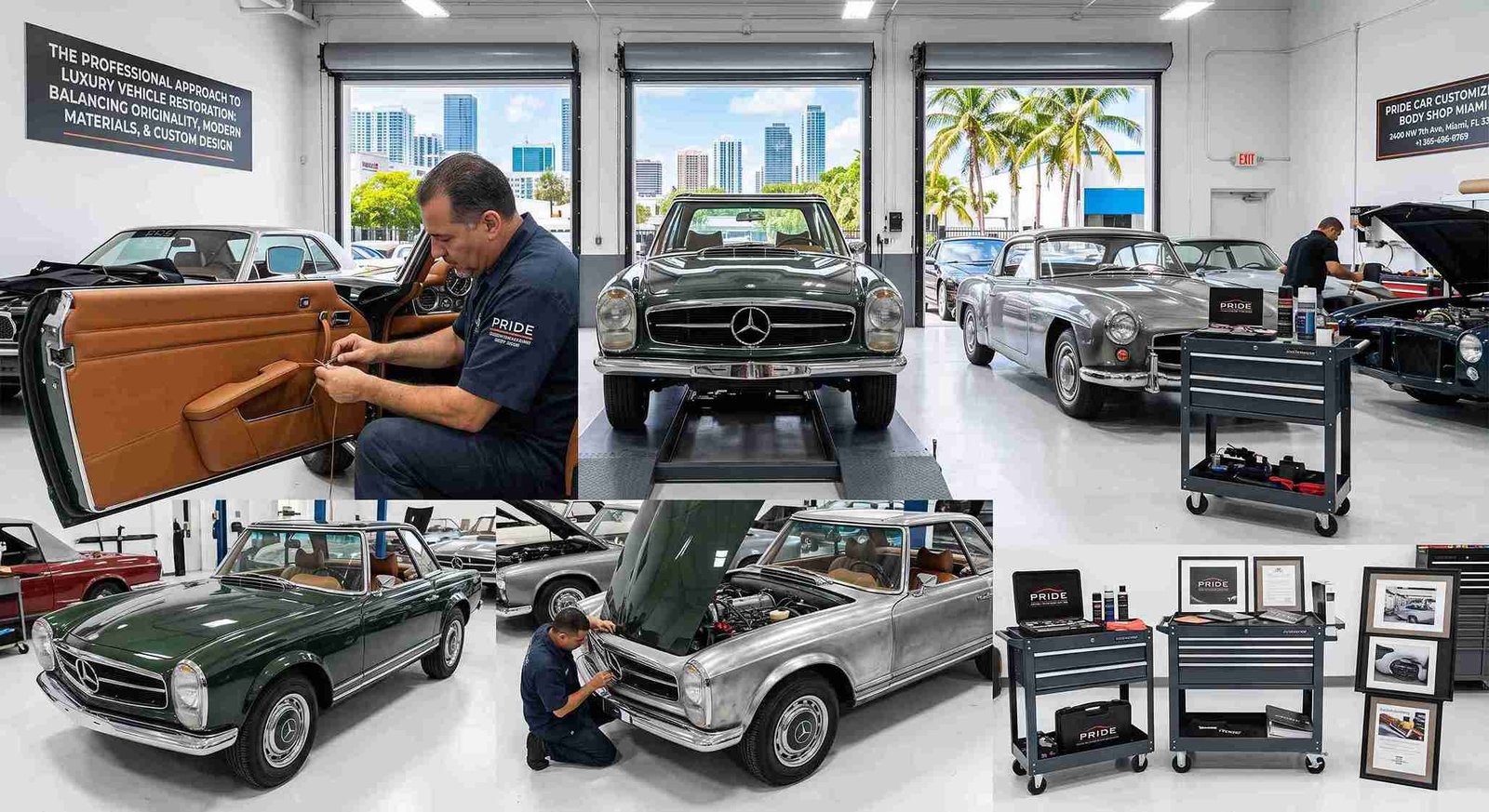
The Professional Approach to Luxury Vehicle Restoration Balancing Originality, Modern Materials, and Custom Design
Restoring a luxury vehicle is not simply the process of making an older or damaged automobile look new again. It is a careful exercise in preservation, technical reconstruction, material selection, and visual refinement. Every vehicle carries a particular design language, manufacturing philosophy, and combination of materials that contribute to its identity. A successful restoration should recognize those characteristics before deciding what needs to be repaired, replaced, refinished, or customized. For owners considering luxury car restoration in Miami, this becomes even more important because the finished vehicle needs to function in a demanding environment while maintaining the qualities that make it special. Heat, humidity, intense sunlight, heavy rain, road contamination, and regular use can all influence restoration materials and finishing decisions. A professional restoration approach therefore does not automatically mean returning every component to exactly the way it was when the vehicle left the factory. Instead, it involves understanding which characteristics should be preserved, where modern materials can improve reliability, and where carefully controlled customization can enhance the vehicle without destroying its original character.
Restoration Begins With Understanding the Vehicle
Before restoration work begins, the vehicle should be evaluated as a complete system.
Its age, model, production specifications, existing modifications, previous repairs, body condition, paint history, interior materials, mechanical condition, and overall originality can influence the restoration strategy.
Two vehicles of the same model can require very different approaches. One may retain much of its original bodywork and interior, while another may have undergone years of modifications or repairs.
This initial assessment helps establish what is worth preserving and what requires intervention.
A professional luxury auto restoration in Miami project should therefore begin with documentation and inspection rather than immediately removing components or ordering replacement parts.
Originality Is About More Than Keeping Old Parts
Originality is often misunderstood as simply retaining as many original components as possible.
In reality, authenticity can involve many characteristics, including factory body contours, trim design, interior architecture, material textures, stitching patterns, hardware, finishes, wheel specifications, and even the visual character of the paint.
Some original parts may be restorable, while others may be too damaged, unsafe, or deteriorated to justify preservation.
The professional question is not always “Can the original part remain?” It is often “What is the most appropriate way to preserve the vehicle’s original character while achieving a reliable result?”
That distinction is particularly important in high-end vehicle restoration in Miami, where owners may expect both historical character and modern standards of finish quality.
Assessing What Can Be Restored
Restoration and replacement are not interchangeable decisions.
A damaged panel, trim component, interior surface, or structural element may sometimes be restored rather than replaced. Preserving an original component can maintain authenticity and may also preserve details that are difficult to reproduce accurately.
However, restoration requires technical judgment.
Metal panels can develop corrosion, fatigue, distortion, or previous-repair damage. Interior materials can become brittle, discolored, torn, or chemically degraded. Plastic components may lose flexibility with age. Rubber seals can harden and shrink.
A professional restoration process evaluates the condition of each component before deciding whether restoration is technically appropriate.
Modern Materials Can Support Authentic Restoration
Using modern materials does not necessarily mean compromising originality.
Automotive restoration has benefited from improvements in coatings, adhesives, corrosion protection, upholstery materials, sealants, refinishing products, and surface-preparation technologies. When selected correctly, modern materials can help reproduce the intended appearance while providing improved consistency or durability. The key is compatibility. A modern material should work appropriately with the substrate and surrounding components. It should also produce a result that remains visually appropriate for the vehicle. For example, a modern coating may provide excellent performance, but if its appearance is incompatible with the intended finish of a historically significant vehicle, it may not be the correct choice. Professional restoration requires balancing technical performance with authenticity.
Preserving Original Body Geometry
Luxury vehicles often have carefully sculpted body surfaces that are difficult to reproduce once altered. Restoration work should therefore pay close attention to original panel contours, character lines, edge profiles, gaps, and transitions. Excessive filler, poor metal shaping, aggressive sanding, or inaccurate replacement panels can subtly change the vehicle’s proportions. These differences may not be obvious from a distance, but they can become noticeable under direct lighting or when comparing the restored vehicle with original reference material. A professional classic car restoration in Miami process should treat body geometry as an important part of the vehicle’s identity rather than merely as a foundation for paint.
Paint Restoration Requires Historical and Technical Awareness
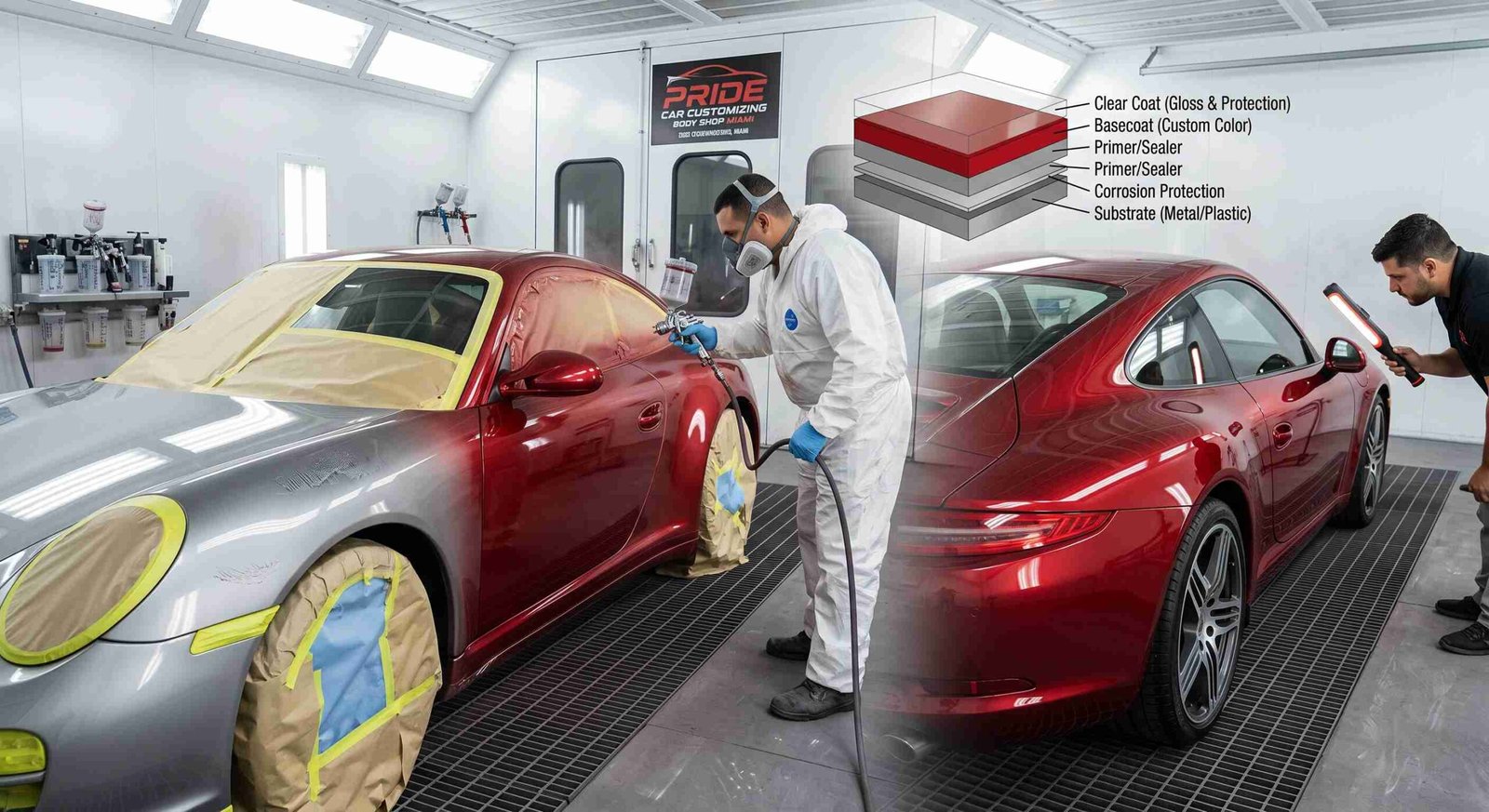
Paint is one of the most visible aspects of restoration, but reproducing the correct finish involves more than finding a similar color.
The original color may have changed over time due to UV exposure, oxidation, previous repairs, or aging. A vehicle that has been repainted may also contain multiple layers from different periods.
The restoration strategy should determine whether the objective is preservation of existing original paint, localized repair, or complete refinishing.
When a complete repaint is appropriate, color selection and finish characteristics should be considered in relation to the vehicle’s period and design.
Modern paint systems can produce exceptionally consistent results, but the final finish should still suit the vehicle.
Material Matching Is Critical Inside the Cabin
Luxury vehicle interiors contain a complex combination of materials.
Leather, vinyl, fabric, carpeting, wood, metal, plastic, composite components, foam, adhesives, and decorative trim can all age differently.
A restoration that replaces one material without considering the surrounding components can produce an interior that feels visually inconsistent.
Leather color is a good example. A newly installed section may be technically correct but appear noticeably different from adjacent original material because of aging, UV exposure, conditioning, and natural variation.
Professional interior restoration therefore involves material matching as well as installation.
The goal is to make restored areas integrate naturally with the rest of the cabin.
Modern Upholstery Techniques Can Improve Consistency
Contemporary upholstery equipment and manufacturing techniques can provide greater control over stitching, panel shaping, foam preparation, and material tension.
These improvements can be valuable when restoring a luxury interior, particularly when original materials are unavailable or no longer practical.
However, modern construction should still respect the original interior architecture.
Stitch spacing, seam placement, piping, perforation patterns, panel proportions, and material direction can all contribute to authenticity.
A restoration can use modern craftsmanship without visually transforming the cabin into something unrelated to its original design.
When Custom Design Makes Sense
Restoration does not necessarily exclude customization.
Some owners want to preserve the exterior identity of their vehicle while introducing discreet improvements inside. Others may want modern comfort, upgraded materials, improved lighting, enhanced sound systems, or carefully selected visual changes.
The challenge is maintaining a clear relationship between original and custom elements.
Custom work becomes more successful when it looks deliberate rather than randomly added. New components should respect existing shapes, materials, and proportions.
This is where restoration and customization can coexist without one completely overriding the other.
OEM, Reproduction, and Custom Components
Replacement parts can generally fall into several categories, including original manufacturer components, high-quality reproductions, restored used parts, and custom-fabricated components.
The correct choice depends on availability, condition, authenticity requirements, function, and project objectives.
An original component may be preferable when preservation is the priority. A reproduction may be appropriate when the original is unavailable or beyond practical restoration. Custom fabrication can become necessary when a component is unique, discontinued, or being intentionally redesigned.
The decision should be made based on the vehicle rather than applying one rule to every restoration.
Restoration Should Preserve Functional Integrity
A restored luxury vehicle needs to be more than visually impressive.
Doors should operate correctly. Panels should align properly. Interior controls should function as intended. Seals should perform appropriately. Electrical components should be inspected. Mechanical systems should be evaluated according to the scope of the restoration.
This is especially important for vehicles that will be driven regularly.
A restoration that focuses exclusively on appearance can leave underlying functional problems unresolved. Professional restoration considers the relationship between visual quality and usable vehicle condition.
Corrosion Protection Is a Long-Term Consideration
Corrosion can become one of the most serious threats to a restored vehicle.
Once rust begins beneath a newly refinished surface, cosmetic improvements can quickly deteriorate.
Restoration should therefore address corrosion at the appropriate stage rather than simply covering visible rust with new material.
Affected metal may require cleaning, treatment, repair, or replacement depending on severity. Seams, hidden areas, panel edges, and drainage points also deserve attention.
For luxury car restoration in Miami, corrosion prevention is particularly relevant because moisture and humidity can create persistent environmental exposure.
Modern Protection Can Extend Restoration Results
After restoration, additional protective systems can help preserve the finished vehicle.
Depending on the paint and intended use, owners may consider paint protection film, ceramic coating, or other compatible protection strategies. Interior materials may also benefit from appropriate maintenance products.
Protection should be selected according to the restored materials rather than treated as a universal final step.
For example, the maintenance approach for a high-gloss modern refinishing system can differ from that of a specialty matte finish or historically appropriate surface.
The restoration strategy should therefore include long-term care from the beginning.
Miami Conditions Should Influence Restoration Planning
South Florida presents a specific operating environment for vehicles.
Strong sunlight can accelerate fading and material degradation. Heat can influence interior surfaces and certain adhesives or plastics. Humidity and rainfall increase moisture exposure, while coastal conditions can contribute to contamination and corrosion concerns.
These environmental factors do not mean a luxury vehicle cannot be restored to an exceptional standard in Miami. They mean the restoration strategy should account for the conditions in which the vehicle will actually be stored and driven.
A vehicle kept indoors under controlled conditions will have different requirements from one parked outside and driven every day.
Preserving Character While Improving Usability
One of the most interesting restoration decisions involves modernizing selected areas without visually transforming the vehicle.
Examples can include discreet sound-system improvements, upgraded lighting, improved interior materials, modern protective coatings, or carefully integrated convenience features.
The objective is not to make an older vehicle look like a completely different model. Instead, the owner can selectively improve usability while retaining recognizable characteristics.
This approach can be particularly effective for luxury vehicles where the original design remains an important part of the ownership experience.
Documentation Is Valuable During Restoration
A complex restoration can involve many components, materials, finishes, and decisions.
Documenting the project can help preserve information about what was repaired, replaced, refinished, or customized. Photographs taken before disassembly can also help during reassembly. Documentation can be useful for future maintenance and may provide context for future owners. For high-value or historically significant vehicles, keeping records of restoration materials and work performed can be particularly beneficial.
Quality Control Should Happen Throughout the Project
Quality control should not be postponed until the vehicle is completely assembled.
Bodywork should be inspected before paint. Surface preparation should be reviewed before final coating. Interior components should be checked before installation. Reassembled panels should be inspected for alignment.
This staged approach allows issues to be identified while correction remains practical.
Final inspection should then evaluate the vehicle as a complete system, including paint consistency, panel alignment, trim fitment, interior workmanship, surface finishing, and overall presentation.
Choosing a Professional Restoration Shop
When evaluating a restoration provider, owners should look beyond photographs of finished vehicles.
Ask how the shop evaluates the original vehicle, handles damaged components, selects materials, approaches paintwork, manages disassembly and reassembly, and maintains quality control.
Experience with luxury vehicles is also important because premium vehicles often involve specialized materials, complex body construction, intricate interiors, and higher expectations for fit and finish.
A professional shop should be able to explain why a particular restoration method is appropriate rather than simply recommending the most extensive or expensive option.
Luxury Car Restoration in Miami With a Balanced Approach
A successful restoration is ultimately about making informed decisions at every stage.
Original components should be preserved when doing so makes technical and historical sense. Modern materials should be introduced where they provide a legitimate advantage without compromising the vehicle’s character. Custom elements should be integrated carefully rather than allowed to overwhelm the original design.
At Pride Car Customizing Body Shop Miami, restoration and customization services can be approached according to the vehicle’s condition, owner’s objectives, and desired level of transformation.
For owners seeking luxury car restoration in Miami, the most valuable result is not necessarily the vehicle with the greatest number of new components. It is a vehicle in which the restored surfaces, replacement materials, modern improvements, and custom details work together while retaining the qualities that made the vehicle worth restoring.
Conclusion
Luxury vehicle restoration requires judgment as much as craftsmanship. The objective is not simply to replace old components with new ones, but to understand which characteristics define the vehicle and determine how those characteristics can be preserved, repaired, or thoughtfully enhanced. Modern materials, advanced refinishing systems, contemporary upholstery techniques, and protective technologies can all contribute to a stronger restoration when they are selected and applied appropriately. At the same time, originality, body geometry, material character, and design identity should remain central to the process.
For luxury car restoration in Miami, a balanced professional approach can create a vehicle that respects its original character while meeting the practical expectations of modern ownership.
Pride Car Customizing Body Shop Miami
2400 NW 7th Ave, Miami, FL 33127
Phone: +1 305-498-6789